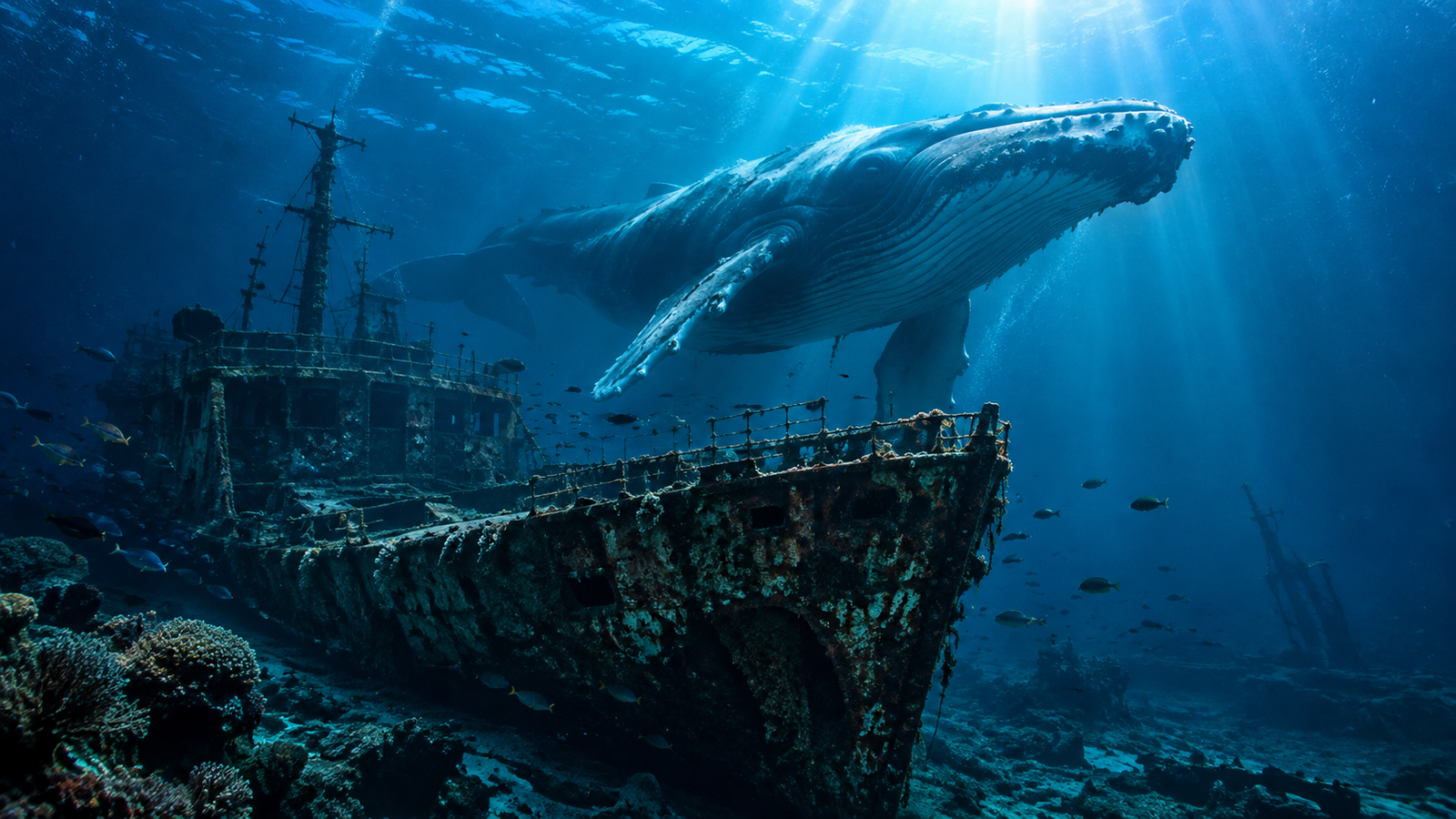
The ocean covers most of our planet, yet much of its deepest environment remains mysterious. Far below the surface, sunlight disappears, temperatures can drop dramatically, and enormous water pressure creates conditions that are difficult for humans to experience directly. These darkest places in the ocean are home to unusual marine creatures, deep-sea landscapes, ancient shipwrecks, and ecosystems that have adapted to almost complete darkness.
When people imagine the ocean, they often picture bright blue water, coral reefs, beaches, and sunlight reflecting across waves. But the deeper you travel, the more dramatically the environment changes. Eventually, natural sunlight becomes too weak to support ordinary photosynthesis. Beyond this point lies a world where darkness dominates and life must survive using remarkable adaptations.
One of the most fascinating aspects of the deep ocean is the gradual disappearance of sunlight. The upper layer of the ocean receives enough sunlight to support large amounts of marine life. As depth increases, however, light becomes weaker. Colors disappear one by one, visibility decreases, and eventually the environment becomes almost completely dark.
This region is often associated with the deeper zones of the ocean, where sunlight cannot reach. Here, marine organisms cannot rely on the same conditions that support life near the surface. Instead, many species have developed unique ways to find food, communicate, avoid predators, and survive in an environment that would appear completely hostile to humans.
Darkness does not mean the ocean is lifeless. In fact, the deep sea contains an incredible variety of organisms. Some creatures have developed enormous eyes to capture the smallest amount of available light, while others have little or no dependence on vision at all.
One of the most remarkable adaptations is bioluminescence. Some deep-sea animals can produce light through chemical reactions within their bodies. This natural light may be used to attract prey, communicate with other animals, confuse predators, or make the creature less visible in certain conditions.
Imagine traveling through completely dark water when a small blue or green light suddenly appears in the distance. Then another appears, followed by several more. What seems like an empty environment can suddenly become filled with tiny points of natural light.
The deep sea also contains some of the most unusual animals on Earth. Anglerfish, deep-sea squid, lanternfish, giant isopods, and other specialized creatures have evolved to survive in conditions that are very different from those found near the surface.
Many of these animals have unusual body shapes and behaviors. Some have large mouths that allow them to consume relatively large prey. Others have expandable stomachs because food can be extremely difficult to find. In an environment where meals may be separated by long periods of time, almost every opportunity to feed can be important.
Food scarcity is one of the biggest challenges in the deep ocean. Most sunlight-driven food production occurs near the surface, meaning that much of the deep sea depends on organic material sinking from above. Dead organisms, biological particles, and other material slowly descend through the water column.
This falling material is sometimes described as marine snow. Although the name sounds peaceful, it represents an important source of energy for deep-sea ecosystems. Tiny particles can provide food for organisms living far below the surface.
Even the smallest pieces of organic material can contribute to a complex food chain. Small organisms consume particles, larger animals consume them, and predators occupy higher levels of the ecosystem. The deep ocean therefore supports interconnected communities despite receiving very little sunlight.
Another fascinating feature of the deep sea is its extreme pressure. Water pressure increases significantly as depth increases. At great depths, the pressure can be hundreds of times greater than the pressure experienced at the ocean’s surface.
Humans cannot safely enter these environments without specialized equipment. Submersibles and remotely operated vehicles are designed to withstand these extreme conditions, allowing researchers to explore areas that would otherwise remain inaccessible.
Technology has transformed our understanding of the ocean depths. Scientists can now use sonar, underwater robots, advanced cameras, and autonomous vehicles to investigate deep environments. These technologies can travel through darkness, collect scientific information, and record images of places that humans have rarely seen.
One of the most exciting discoveries in deep-sea exploration is the existence of hydrothermal vents. These underwater formations occur in areas where geologically heated water emerges from the seafloor. Instead of depending directly on sunlight, ecosystems around these vents can rely on chemical energy.
This discovery changed how scientists think about life. It demonstrated that complex ecosystems can exist without sunlight being the primary source of energy. Organisms around hydrothermal vents have adapted to extreme temperatures, chemical-rich water, and high-pressure conditions.
Deep-sea environments can also contain geological formations that look almost alien. Mountains, trenches, ridges, valleys, and volcanic structures exist beneath the waves. Some underwater landscapes are larger than many features found on land, yet they remain hidden from ordinary view.
Among these landscapes are some of the deepest ocean trenches on Earth. These enormous depressions extend several kilometers below the ocean surface and represent some of the most extreme environments on the planet.
Shipwrecks can also be found within these underwater landscapes. Some vessels rest relatively close to the surface, while others have disappeared into much deeper waters. Over time, these sunken ships can become part of the surrounding ecosystem.
A shipwreck in darkness creates a particularly mysterious environment. The remains of a vessel may be covered in marine organisms while fish move through broken corridors and openings. Without sunlight, the wreck can appear almost like a forgotten structure from another world.
For explorers, discovering an underwater wreck can be an extraordinary experience. The structure may reveal information about the past, while the marine life surrounding it demonstrates how nature has transformed the site.
The darkness of the ocean also changes how humans perceive distance and scale. Without sunlight or recognizable landmarks, it becomes difficult to understand how large the surrounding environment really is. A small area illuminated by an underwater vehicle’s lights may be surrounded by kilometers of darkness.
This creates a powerful feeling of isolation. Explorers cannot simply look toward the horizon as they would on land. Their world is limited to what their equipment can illuminate.
Yet this darkness is also what makes deep-sea exploration so exciting. Every movement of an underwater camera can reveal something unexpected. A strange creature may appear. An old shipwreck may emerge from the sediment. A geological formation may suddenly become visible.
The unknown remains one of the greatest attractions of ocean exploration.
Despite technological advances, humans have explored only a fraction of the world’s underwater environments in detail. New discoveries continue to demonstrate how much remains unknown beneath the waves.
The deep ocean is not simply a dark version of the shallow ocean. It is a completely different environment with its own ecosystems, geological features, and survival strategies. The creatures living there have evolved for conditions that would be extremely challenging for humans.
Understanding these environments is important for science and conservation. Deep-sea ecosystems can provide information about evolution, geology, climate, and the history of our planet. They also remind us that Earth’s biodiversity extends far beyond forests, mountains, rivers, and cities.
The darkest places in the ocean may seem empty when viewed from the surface, but beneath the waves they are filled with activity. Creatures hunt, communicate, reproduce, and survive in complete or near-complete darkness.
The deep sea shows us that life does not require familiar conditions. It can adapt to pressure, cold, darkness, chemical environments, and limited food supplies. The result is one of the most extraordinary ecosystems on Earth.
As technology continues to improve, researchers will likely discover more species, underwater landscapes, shipwrecks, and ecosystems hidden within the ocean depths. Each discovery will add another piece to our understanding of the planet.
The darkness beneath the waves is not simply an absence of light. It is a world of adaptation, mystery, history, and life. It contains environments that challenge our understanding of where life can exist and how organisms can survive.
For DROWNED, the deep ocean represents more than a mysterious setting. It represents the unknown itself. Beneath the surface are places that few people will ever see, creatures that seem almost impossible, and stories waiting to be discovered.
The ocean’s surface may reflect the sunlight, but its deepest regions tell a different story. Down there, darkness becomes the landscape, silence becomes the atmosphere, and every discovery becomes a reminder of how little we truly know about our own planet.
The deepest ocean is still waiting.
And somewhere in that darkness, another story is waiting to be found.